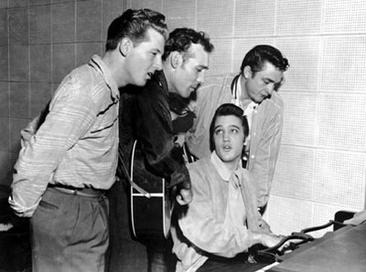
So, stop me if you’ve heard this one; Elvis Presley, Johnny Cash, Carl Perkins, and Jerry lee Lewis walk into a recording studio… Does kinda sound like a set up for a joke, doesn’t it? Well, this was no joke, it was in fact what came to be known as the “Million Dollar Quartet.” But what the hell was this meeting of music royalty all about? How did it happen and what came of it? Well, I’m Dr. Mountain and in honor of the passing last week of Elvis’ daughter Lisa Marie Presley that’s what we will look into on this episode, episode 4, of Noise Gate Minis, music history for busy music lovers!
So to start with we need to know a little bit about Sam Phillips and Sun Studios. If you know much about Elvis’ beginnings as a performer you probably know the story. An 18 year old truck driver named Elvis Aaron Presley walking into a little recording studio in Memphis in 1953 and cut a vanity record as a birthday present for his mother. His performance impressed the studio owner who encouraged Elvis to come back and sing some more songs to sell. Well, the studio was Sun Studio and that studio owner was Sam Phillips. Up to that point Sun had specialized in blues records aimed at primarily Black audiences and Sam had worked with a variety of well-known blues artists like B. B. King and Howlin’ Wolf. But Sam wanted to “cross-over,” as they say, to white record buyers as well. With Elvis, he made that happen. In a very real sense, Sam Phillips made Elvis Presley, and Elvis Presley made Sam Philips. Let’s go back to 1953 and listen to Elvis on that very first song, My Happiness, sung for his beloved mom, Gladys.
My Happiness, Elvis
Under Sam Phillip’s tutelage, Elvis quickly became very famous and every wannabe Elvis in the Memphis area stopped by Sun Studio to try to catch Sam’s attention and make a name (and lots of money) for themselves. Most, of course, did not become rich and famous, but three who did were Carl Perkins, Johnny Cash, and Jerry Lee Lewis. We don’t have time for the full story of their time at Sun with Sam Phillips, but suffice it to say that by 1956 Elvis and Perkins were two of the biggest young stars in American music and Cash and Lewis were on the cusp of stardom. The least well-known of the four today, though tremendously popular and known as the “King of Rockabilly” in the late 50s and 60s, is certainly Carl Perkins, so let’s listen to his version of Blue Suede Shoes, considered to be one of the first rockabilly records and was the first song by a white artist to cross-over to the R&B chart. It was a big hit for Carl in early 1956 that would become an even bigger hit for Elvis in later 1956.
Blue Suede Shoes, Carl Perkins
By all means, take a listen to the Elvis version as a comparison. In something akin to remixes these days, it was common for record companies to release multiple versions of the same some by different artists in different styles. I’ll put a couple other Carl Perkins tunes on the Spotify playlist for this episode as well as Elvis’ version of Blue Suede Shoes along with a few other versions by other artists.
December 4, 1956 was an unseasonably warm and windy winter’s day in Memphis. Elvis was in town. The previous November Sam Phillips had sold Elvis’ contract to RCA Records for the at the time princely sum of $40,000 with a $5,000 bonus for Elvis. Total, this would be about $500,000 today. Elvis had quickly outgrown his home with Sam and Sun. It just so happened that Carl Perkins was in the studio that day recording some new songs. An up and coming piano player by the melodious name of Jerry Lee Lewis had been hired for the session. Johnny Cash had heard that Carl was recording and wanted to listen in, so he headed down to the studio as well. It was just dumb luck and coincidence that these four ended up at the same place at the same time with a full studio and musicians on hand to put it all down for posterity.
Let’s take a musical interlude and listen to Cry! Cry!, Johnny Cash’s first hit off his debut album “Johnny Cash with his Hot and Blue Guitar” from 1957.
Cry! Cry!, Johnny Cash
Sam Phillips was nothing if not savvy to a good publicity opportunity for his artists (Lewis’ first Sun single was set to be released in the coming days), so he called a local paper, the Memphis Press-Scimitar, to send over a reporter and photographer. Jack Clement, the Sun engineer, also realized what was going on and turned on the recording equipment. The quartet jammed for a good while that day with some of the other musicians gathered for the Perkins’ session joining in.
Let’s listen to two tracks here back-to-back. We’ll start with one of the gospel tracks, Down by the Riverside, and one of the secular tracks, version 1 of Brown Eyed Handsome Man.
The next day the Press-Scimitar ran a story and photo of the four using the term “million dollar quartet.” That name would stick and the session would become legendary over the years as the recording of that day was known to exist but had not been released. Kind of an interesting story there, too. A guy named Shelby Singleton bought Sun Records in 1969. He licensed much of the Sun Archives to mostly reissue label, Charly Records, in Britain. Of course, with Elvis’ death in 1977, interest in the Million Dollar Quartet session was piqued. Charly ended up releasing 17 mostly gospel tracks under the title The Million Dollar Quartet in ‘81. In 1987, Charly released a two LP expanded The Complete Million Dollar Session, which was then released in the US by RCA under the title, Elvis Presley: The Million Dollar Quartet. RCA release a 50th anniversary issue with some previously unreleased material in 2006.
There were several “reunions” after Elvis’ death that included another Sun star, Roy Orbison, along with Cash, Perkins, and Lewis. For the Johnny Cash Christmas Special in 1977, a few months after Elvis’ death, Cash, Perkins, Lewis and Orbison sang “This Train is Bound for Glory” in tribute. I’ll put a YouTube link to the video from that performance in the episode description. It’s worth watching just for the hair and clothing styles alone. The belt buckles on Perkins and Orbison are stunnning! In 1982, a live album, The Survivors Live, with Cash, Perkins, and Lewis was recorded during Cash’ European tour that year. In 1986, Class of ’55 was released and included Orbison again. The next year, Interviews from the Class of ’55 Recording Sessions was released, earning a Grammy that year for Best Spoken Word Album.
Well, that’s the story of the “Million Dollar Quartet.” Thanks so much for listening and please check out the Spotify playlists for this episode and please consider supporting Noise Gate on Patreon. Find the link also in the description. This is Dr. Mountain for Noise Gate and we will leave you today with Johnny Cash, Carl Perkins, Jerry Lee Lewis, and Roy Orbison singing “Coming Home” from 1986’s Class of ’55.
 Noise Gate Music
Leave a comment