
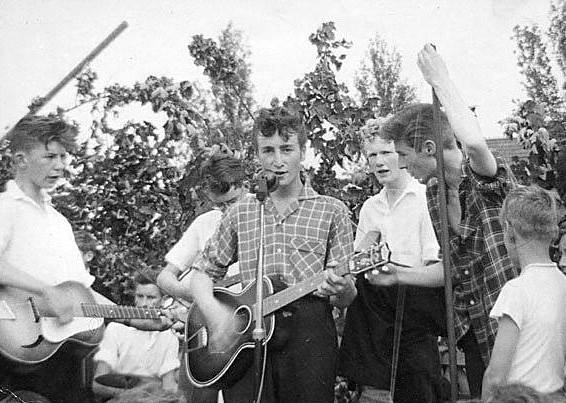
1: What do Van Morrison, Jimmy Page, John Lennon, Paul McCartney, George Harrison, and Ringo Starr all have in common? Obviously, they all became massively famous and influential musicians. Aside from that, however, all these guys began their performing lives with skiffle bands. But what was skiffle?
I’m Dr. Mountain and that is the question we are going to explore on this inaugural episode of Noise Gate Minis, the music history podcast for busy music lovers.
Music Cue: Intro. music
2: The term “skiffle” has historically been used in two somewhat related but distinct ways.
Originally, in Black communities in the in northern urban areas, particularly Chicago, a skiffle was a rent or house party. Any decent skiffle would have food, booze, and dance music. Some of the more popular musicians and groups that played at skiffles recorded songs using the term in the titles. For example, a group known variously as the Paramount All-Stars or the Yazoo All-Stars released two tracks in 1929 called Hometown Skiffle, Part I and Hometown Skiffle, Part II for the Paramount label’s race record division. Let’s take a listen:
Music cue: Hometown Skiffle, Part I
3: So, how does “skiffle” get translated to Britain in the 1950s?
In post-war Britain, the most popular form of music was swing and big band jazz. But there was a rather intense group of jazz aficionados who didn’t see this commercialized, highly produced music as “real” jazz. They wanted to go back to what they saw as the origins of jazz as exemplified by the American jazz/blues recordings of the inter-war years. They saw New Orleans-style as the epitome of jazz and anything else was an unwanted and unwarranted aberration. These guys were obsessive record collectors and listening to the music led many of them to pick up instruments and start forming their own bands. They weren’t necessarily great, but what they lacked in musicianship they made up for in enthusiasm. Let’s listen to a version of Down by the Riverside by Chris Barber’s Jazz Band from 1955 that showcases that New Orleans influence.
Music Cue: Down by the Riverside from Vintage Chris Barber, 1954-1956
4: At this point, we need to meet two characters: Ken Colyer and Lonnie Donegan. Now, Ken Colyer was one of those obsessed jazz guys who was also a musician. He was so obsessed, in fact, that he joined the Merchant Navy just to visit the US (not something easy for average folks to do at the time). He had realized that there was only so much he could learn from listening to records. He needed to see how they played as well as hear them and the only way to do that was to go to New Orleans. On his arrival in Mobile, Alabama he jumped ship and headed for the Big Easy. He soon tracked down his musical heroes and started regularly playing with them. After some months in the US, his visa expired, and he spent a short stint in a Louisiana jail before he was deported back to England.
5: During his American sojourn, Colyer wrote letters back to his equally trad jazz-loving brother Bill in England and Bill passed those letters on for printing in the magazine Melody Maker for all their trad jazz compatriots to read. That group greeted his return with great enthusiasm.
In mid-July 1954, Ken Colyer and his band are trying to record their first album, but they end up with not enough songs. They had six; they needed eight. The band’s banjo player, Lonnie Donnegan, suggested they do two of the breakdown numbers they had been using in their live sets. So, he came to the front to sing and play guitar, they called in a washboard player, and the horns and brass sat out. The engineer for the recording session was a bit taken aback. Now this wasn’t the same band and as he heard them warming up, he also knew it wasn’t the same music. “What are we going to call this?” he asks Bill Colyer, and Bill says it’s the “Ken Colyer Skiffle Group” and thus was born, as Billy Bragg put it, a “subgenre of American roots music indigenous to the United Kingdom.”
6: For the trad jazz bands, skiffle started out as small group musical interludes that played during the larger band’s breaks. While the horn players were getting a drink and letting the feeling return to their tired lips, a small group of players, sometimes members of the larger band and sometimes not, would keep the audience entertained by playing up tempo blues and folk tunes, usually with a bass, guitar, washboard, and a singer. It quickly became apparent that many of the young people in the audience were there as much or more for the skiffle sessions as they were for the trad jazz. Some of the stodgier trad jazz guys balked at this, seeing skiffle as fine in its place, but of nowhere near the cultural value of traditional jazz.
7: Little did any of them know one of Donnegan’s numbersg that day would kick off the skiffle craze among the youth of England, creating a musical nursery for the British Invasion ten years later.
Here it is. Lonnie Donegan covering Lead Belly’s “Rock Island Line.”
Music Cue: Rock Island Line
8: The kids went nuts for this song and it was their gateway to other traditional folk and blues from the US. And it wasn’t just for listening. Like Ken Colyer and Lonnie Donegan, many young people wanted to play the music as well. Skiffle bands popped up all over the country. In something like 24 months, guitar imports went from about 5,000 units per year to 250,000 units per year.
9: Despite being associated with the trad jazz crowd for several years, Lonnie Donegan was above all an entertainer in an almost vaudevillian sense. Despite some initial reluctance, he quickly saw what the people wanted, and he wasn’t going to let some nostalgic loyalty to trad jazz keep him from bringing skiffle to the masses and becoming a household name (in Britain) in the process.
10: Donegan’s popularity skyrocketed almost overnight and very soon the Ken Colyer band became the Lonnie Donegan Band and was touring the country to sold out shows. And it was at a week-long stand in Liverpool that the next seed that would grow into the British Invasion. A local teenager by the name of George Harrison went to the Donegan performances every night of their run in Liverpool. Another Liverpool youth, a kid named Paul McCartney, went to see Donegan and immediately switched from playing the trumpet to playing the guitar. Though we don’t know for certain whether John Lennon attended the Donegan shows, it is significant that only a few weeks later he started his own skiffle group, the Quarrymen.
Here is the Quarrymen performing In Spite of all the Danger
Music cue: In Spite of all the Danger
11: So, what was attractive about skiffle? Why did so many kids in the UK, particularly kids from working class backgrounds, take to it not just to listen and dance to but even perform themselves?
For one thing it is fun, upbeat, dance music. It was also innocuous enough not to alienate parents. The early, some might say first, rock and roll hit song, Rock Around the Clock by Bill Haley and the Comets, had recently become popular (though hard to find) through the hit movie Blackboard Jungle. From that film, Rock and Roll became associated in the minds of the older generation with youth violence and rebellion.
12: Also, it was simple to play. Certainly much easier to play than the trad jazz of Ken Colyer and Lonnie Donegan’s generation. With skiffle, pretty much anyone could get a few friends together, grab their mum’s washboard, make a quick tea chest bass, buy a cheap guitar and, bob’s your uncle, have a skiffle band. It gave the kids a huge sense of empowerment to play popular music that people liked with no specialized training necessary. They could play at school dances and church fetes, even gain a little local following. Not much could be better than that for a teenager.
There was also, I think something both exotic and familiar in the music. It was from America, which gave it a certain cache. It was Black American music, which made it a bit exotic. But it was also music of working-class folks having a good time.
13: Now, the skiffle boom did not last very long. By 1958 or so it had pretty much played itself out (though Lonnie Donegan remained a popular entertainer in the UK for decades and never really changed his sound). But the upshot of all this is that skiffle was a gateway to other forms of American music, the blues, folk, and early rock and roll. With the youth skiffle bands, you have an established set of kids who had a bit of musicianship, performance skills, and experience to confidently move popular music forward to the heights it would reach in the 60s, 70s, and beyond.
The Beatles, as the Quarrymen came to be known, lead the British Invasion with their first number one song in the US in February of 1964 with I Want to Hold your Hand. Let’s spin it!
Music Cue: Beatles, I Want to Hold your Hand
14: Please take all of this as an appetizer. There is a lot more to know about the history of skiffle music and the British Invasion. I got a lot of my information on skiffle from Billy Bragg’s book, Roots, Radicals, and Rockers: How Skiffle Changed the World. It is an amazing cultural history of Britain in the 1950s told through the lens of skiffle. Additionally, on this show’s Anchor page, I’ve provided a link to a great talk he gave on the history of skiffle at the Library of Congress in 2017. You can also check out the Spotify playlists I have put together with a variety of skiffle music and one specifically devoted to recorded versions of “Rock Island Line” through the years.
Please subscribe to this podcast and check out our Patreon page to further support the production of entertaining and enlightening shows on the history of popular music from Noise Gate Productions.
 Noise Gate Music
Leave a comment