The Altamont Free Festival, December 6, 1969, was intended as a west coast Woodstock in miniature. It turned into a day of substance abuse, violence, death, and murder. Many factors led to this disaster: inadequate parking, food and water, sanitation, and medical care; a literally last-minute venue change; all around poor and rushed planning; monumental hubris and egos combined with an (in retrospect) astonishing naivete. But one thing stands out as especially odd: the use of Hell’s Angels as concert security. I’m Dr. Mountain and we will investigate how that happened on this episode of Noise Gate Minis, the music history podcast for busy music lovers!
Intro Music
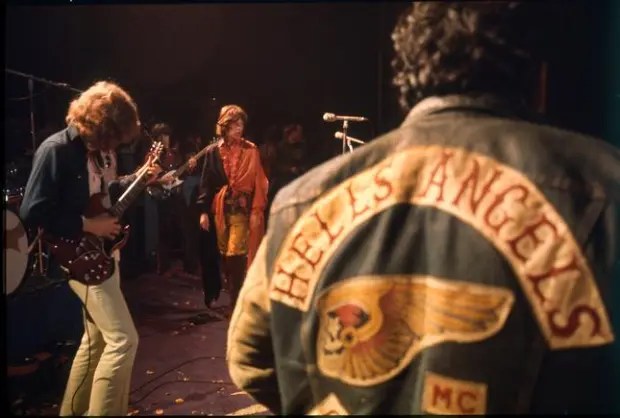
One of my favorite music documentaries is the Maysles brothers’ film Gimme Shelter. It was intended to document the Rolling Stones US tour in the last few months of 1969, but it became much more than that. It is the visual record of the Altamont disaster. I have probably watched it a dozen times and one thing that has always stood out to me is the Hell’s Angels acting as security at Altamont. The Angels are all over the stage from the first act through the Rolling Stones’ performance late in the evening. You can see the Angels in their colors, beer can in one hand and weighted pool cue in the other, beating audience members and even some of the musicians. Gimme Shelter is a masterpiece, but as an example of the Direct Cinema movement, there is no exposition, no talking heads providing analysis or context, nothing to explain how in the Hell’s Angels someone thought it was a good idea to use about 40 members of a notoriously violent biker gang as security for a rock concert with around 300,000 people in attendance. It’s hard to imagine any time or place where that would have been considered a good idea. So, how did it happen?
Before we get into, let’s take a listen to “Sympathy for the Devil” off Beggar’s Banquet from 1968.
The Rolling Stones were on a hugely successful tour of the United States during the month of November 1969. They hadn’t played in the US for over three years as they dealt with a variety of personal, financial, and legal troubles in England. Following on the massive success of Beggars’ Banquet from 1968 and Let It Bleed that very month, by the first week of December 1969, the Stones were most popular rock band in the world.
To cap off their tour of the US the idea of a free concert with accompanying major release documentary (the money maker) by the Maysles Brothers was put in motion by the band and their organization.
At first, the plan was for the Stones to play a free concert in Golden Gate Park in San Francisco, but the city denied the permit out of concerns for the number of expected attendees. Sear’s Point Raceway was the next option and almost happened, but the deal fell through at the eleventh hour. Just as it was looking like the whole thing might not happen, Dick Carter, the owner of the nearly derelict Altamont Speedway near Livermore, California offered it as a location for the concert essentially for free. As stage construction had already begun at Sear’s Point and the concert was less than forty-eight hours away, the Stones team called in Michael Lang, the main man behind the Woodstock festival to help coordinate the move to Altamont. Using an army of workmen and volunteers, Lang managed to get all the equipment for the concert set up at Altamont. Because of the rush, however, no plans were made for concessions or sanitation, and planning for medical care was minimal at best. Further, because of the differences in the venues and the rush to move, the stage was only about three feet off the ground and the bottom of a hill. Even for an era when audiences at major concerts were generally closer to the performers, this was exceptionally close (and, as it would turn out, dangerous).
Let’s take another music break. Carlos Santana was one of the performers that day at Altamont. Here is a live recording of “Evil Ways,” from his Woodstock performance.
To handle security, just a few days before the event, folks connected to the Grateful Dead and the Rolling Stones asked the leaders of the local Hell’s Angels chapters in San Francisco, Oakland, and San Jose to provide some of their members to protect the stage and equipment. They said the festival would be headlined by the Stones and the Dead, but also include Santana, The Jefferson Airplane, The Flying Burrito Brothers, Crosby, Stills, Nash, and Young. The payment would be $500 of beer. The Hell’s Angels leaders agreed.
On Saturday morning, December 6, 1969, several dozen Hell’s Angels showed up at the Altamont Speedway near Livermore, California. By that time there were probably close to 150,000 people already there. Many of those in attendance had been waiting for hours and were already impaired on a variety of intoxicants. With all that beer, it took very little time for the Hell’s Angels to catch up.
At first the vibe was positive. Folks really believed this would be a west coast Woodstock. It didn’t take long, however, before things started getting out of hand. As the crowd increased and pushed down hill toward the stage, fights broke out in the crowd between attendees and Hell’s Angels wielding weighted pool cues. In the Maysles brothers’ footage you can see Hell’s Angels beating attendees. As soon as an altercation began, a bunch of Hell’s Angels would jump in and pummel their targets while the attendees in the vicinity scattered. The Angels didn’t limit themselves to just the attendees, either. For instance, at one point Marty Balin, lead singer of the Jefferson Airplane, during the Airplane’s set jumped off stage to try to stop some of the Angels from beating a guy and got smashed in the face and knocked out.
The alcohol and drug use was insane and a major contributing factor to the growing chaos. Let’s take a listen the Airplane’s ode to mind altering substances, “White Rabbit” recorded at Woodstock, just five months before their set at Altamont.
When the Grateful Dead got to the venue and learned of the violence, they decided to split right away. This caused about a two-hour gap in the lineup where there was no distraction for the crowd. It was dark, people were getting more and more drunk, high, and out of control. You can see in the Gimme Shelter footage that the crowd was right up on the stage edge as the Stones came out and the stage was covered with Hell’s Angels, significantly outnumbering the musicians. At one point an obviously impaired naked woman tries to get on the stage and is hauled off by some huge Hell’s Angels. Beatings going on all over the place. It’s all super scary. At a couple of points, Mick and Keith try to calm the crowd and the Angels. They threaten to stop playing if people keep fighting, to no avail.
It all comes to a head during “Under My Thumb.” The Maysles brothers’ footage captures the terrible moment clearly. A young Black man in a bright green suit is seen holding a long-barreled pistol with a Hell’s Angel attacking him. This was Meredith Hunter. The Angels in the vicinity later said that he had been standing on some equipment and became angry when they told him to get off. He was attending the concert with his white girlfriend and the Angels may have also made some racial comments. He was certainly impaired from drugs and or alcohol. He was stabbed multiple times in the back, neck, and temple. Medical attention was rendered away from the crowd, but he was declared dead at the scene shortly after. Though there is a lot more to this incident, but I will save that for a later time. In the interim, I highly encourage you to check out the resources I will list in the description of this episode.
In honor of Meredith Hunter, I’d like to offer one of the songs he likely heard that day. This is a live recording by Crosby, Stills, Nash, and Young of “Down by the River.”
So, let’s get back to the real question: why did anyone think that having the Hell’s Angels act as security while they drank $500 of beer was a good idea?
Put simply, the Hell’s Angels were seen as part of the larger counterculture movement. But there is a lot to unpack in that statement.
Both the hippies and the Hell’s Angels were fundamentally antiauthoritarian. They both had a deep-seated distrust and even hatred for the police. Police violence at anti-war and civil rights marches colored their image among the hippies. Police were a force of oppression and a tool of the reactionary old guard. If there was a choice for security between the po-po and the Hell’s Angels, the hippies of the 1960s would pick the Hell’s Angels almost without a thought. To a large extent, for the rockers and hippies of the late 1960s it was a case of the enemy of my enemy is my friend.
In looking at the Stones and Altamont specifically, however, the distrust and loathing were even more personal. Mick Jagger was just coming out of the first in a long line of dust ups with the authorities in England and said on several occasions that he would allow no involvement from the police in the December 6 concert. It was even written into the Stones’ contracts for live performances that no uniformed police officers would be allowed in the venues.
It’s also important to note that not all Hell’s Angels or Hell’s Angels chapters were made the same. For years the San Francisco Hell’s Angels had been headquartered in the Haight-Ashbury section of town, right in the very heart of the hippie counterculture. The San Francisco Hell’s Angels leaders, Pete Knell and Bob Roberts, were friendly with some of the leading hippies of the area, guys like Emmett Grogan, one of the leaders of the Diggers (a loose-knit council that unofficially ran the Haight). The Angels had in fact provided security for concerts, particularly Grateful Dead shows, in the past. Most famously, they had been part of the security for the 1967 Human Be-In at Golden Gate Park, where the Dead played and Timothy Leary admonished the crowd for the first time to “Tune in, turn on, and drop out.”
Even though the Dead didn’t play, they did release a response song for those who criticized their involvement in the Altamont fiasco on their 1970 masterpiece, Workingman’s Dead. The song is “New Speedway Blues.” Let’s listen.
The Rolling Stones felt like they knew what to expect of the Hell’s Angels as security. At their Hyde Park free concert, the previous year, the loosely affiliated London Hell’s Angels worked security. The London Angels were very far from the hardened, violent Harley riders under Sonny Barger’s leadership out in San Jose and Oakland. I mean, they basically rode scooters. The distinctions between these groups were well understood by the Angels themselves, but the differences were lost on outsiders like Jerry Garcia and Mick Jagger. A Hell’s Angel is a Hell’s Angel, right? Hubris, ego, naivete ruled the day.
Even though the Dead didn’t play, they did release a song in response to the Altamont mess. The song is “New Speedway Blues”, from their 1970 album Workingman’s Dead.
After the concert there was a lot of finger-pointing and laying of blame: the Stones blamed the Hell’s Angels; the Hell’s Angels blamed Jagger; many blamed the management teams for the Dead and the Stones for going ahead with such an appallingly ill-planned event. Most commentators in the last few decades have placed the responsibility squarely on Mick Jagger and the Stones management. Ultimately, whoever is responsible, dozens of essentially innocent people were injured, and one young man was murdered (whether justifiably or not) in the midst of a gathering that was intended to be peaceful and fun. With the turmoil of Vietnam, the civil rights movement, growing drug culture, it’s hard not to look back and see Altamont as the culmination of the shadow side of the peace and love 1960s.
As ever, please take this podcast as just an introduction. There is A LOT more to learn about Altamont and the cultural history of 1969. Check out Joel Selvin’s fantastic “Altamont: The Rolling Stones, the Hell’s Angels, and the Inside Story of Rock’s Darkest Day,” and “Just a Shot Away: Peace, Love, and Tragedy with the Rolling Stones at Altamont” by Saul Austerlitz. For a more direct comparison between Woodstock and Altamont, read Brian Ireland’s “Woodstock and Altamont: The Music Festivals that Defined the 1960s.” An excellent expository documentary came out in 2020, Days of Rage: The Rolling Stones’ Road to Altamont (currently available through Amazon Prime). And of course, you must watch, Gimme Shelter (available in the Criterion Collection and for rent on Amazon Video). Quick word of warning, none of these are kid friendly. Lots of violence, profanity, nudity, and substance abuse.
Thank you for tuning in to this episode! Please give us a like on Spotify and check out our Patreon page to help support the show. This is Dr. Mountain signing off for Noise Gate Minis, music history podcasts for busy music lovers.
We’ll leave you with another Stones tune. Here is Jumpin’ Jack Flash, recorded for the Rolling Stones Rock and Roll Circus from December 1968 , with an intro by John Lennon.
 Noise Gate Music
Leave a comment